
Formentera has 19 beaches, two natural swimming spots and one islet, all within 15 km of the port. Every beach gets a short entry below: who it suits, how to get there and what sets it apart.
How the coast is organised
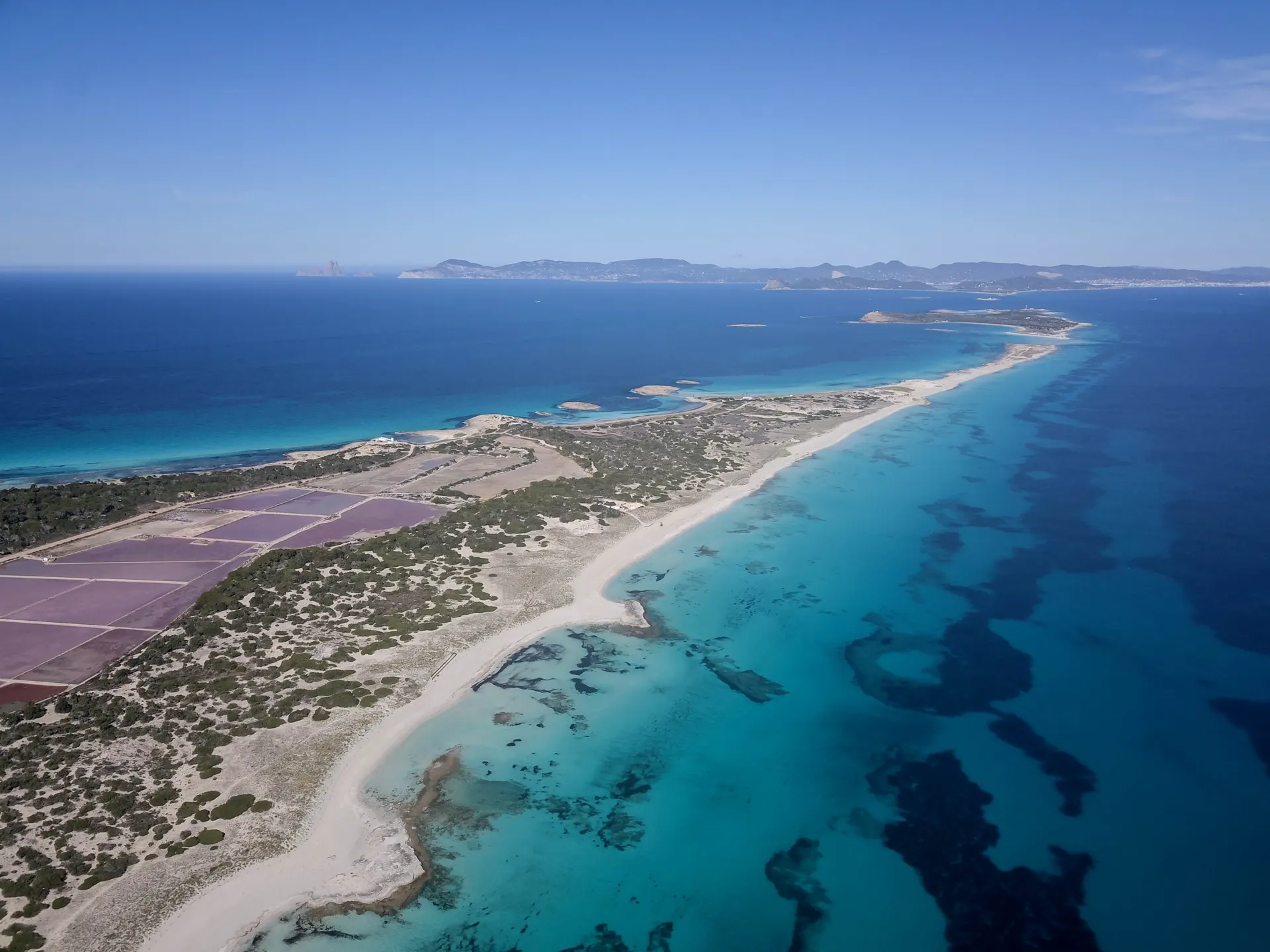
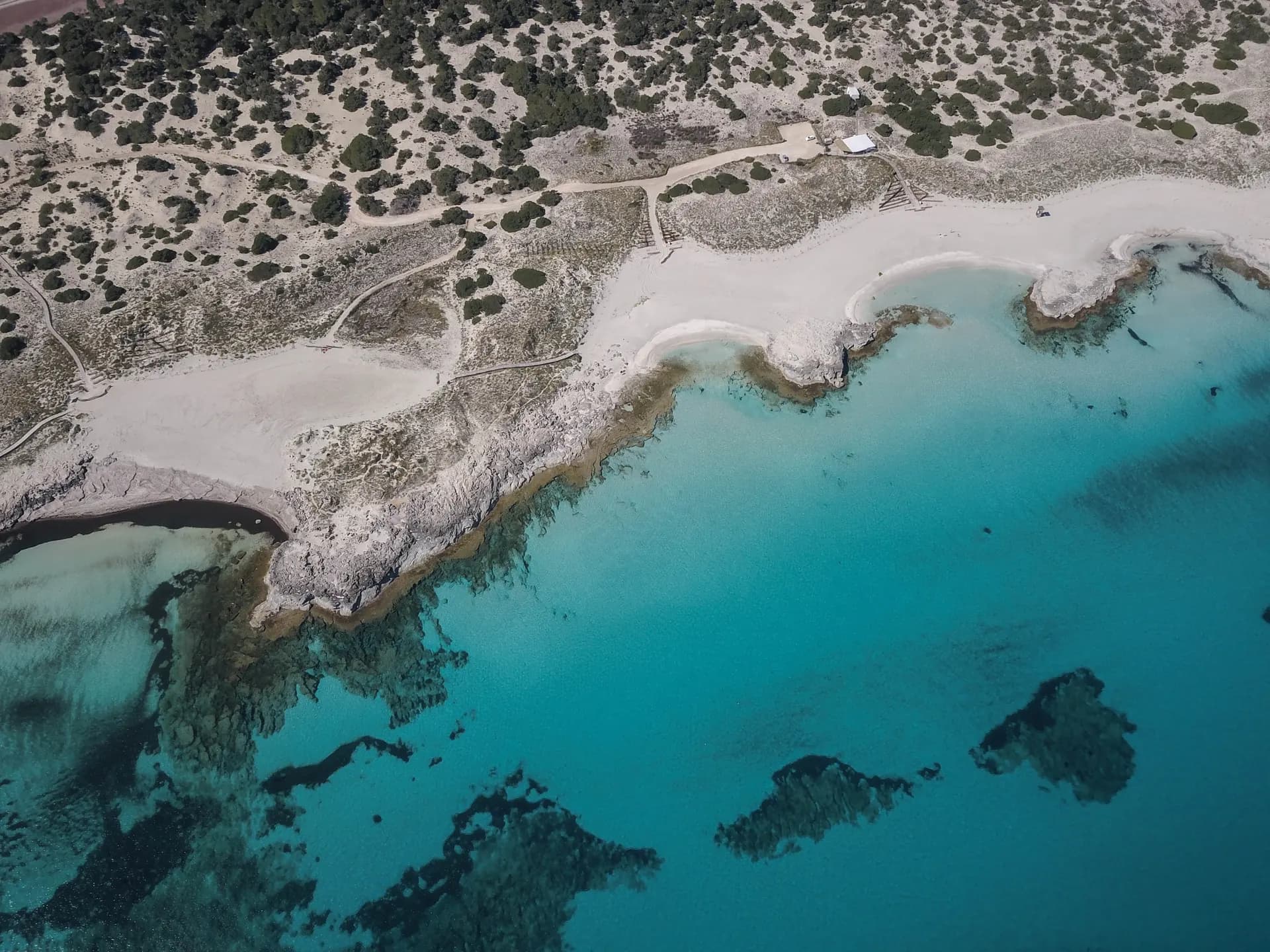
The Es Trucadors peninsula points north from La Savina, inside the Parc Natural de ses Salines, with Ses Illetes on its sheltered west side, Platja de Llevant on the east and the islet of S'Espalmador across the channel at the tip. The west coast is cliff apart from one sandy cove, Cala Saona. The whole south coast is Platja de Migjorn, a chain of named sections ending at the cove of Es Caló des Mort below La Mola. The north coast east of Es Pujols is the Tramuntana shore: rock, a few small coves and the fishing hamlet of Es Caló de Sant Agustí.
The north peninsula and the islet
Ses Illetes is the best known beach on the island: more than 450 m of white sand facing west, 4 km from La Savina, with restaurants, sunbeds and water sports, rated safe for children and busy all summer. Reach it by road, by the Bus Turístic L3 in about 15 minutes, by the L7, on foot from Es Cavall d'en Borràs or by boat. Motor vehicles pay the park fee from 10 May to 15 October.
Platja de Llevant runs 1,450 m down the east side of the same peninsula, 371 m across the dunes from Ses Illetes, with one or two beach bars and nothing else built. It is the choice of people avoiding the crowds of Ses Illetes. No bus stops here; it shares the paid car parks.
Platja des Trucadors is the sand tongue at the northern tip, roughly 700 m by 30 m, with water on both sides so you can pick the sheltered one. On foot only from Ses Illetes, no services, and crossing to S'Espalmador on foot is forbidden because of the currents.
Platja de s'Alga is the kilometre of white sand on the western shore of S'Espalmador, a protected 2 km2 islet. Boat only, on the daily boats from La Savina or your own. No services, and taking mud from the lagoon is prohibited.
Es Cavall d'en Borràs is the first beach inside the park, 2 km from the port on foot or by bicycle, with shallow water and no waves. It suits families and has the sunset behind Es Vedrà. Restaurants, sunbeds, paid car parks in season.
The west coast
Cala Saona is the only sandy cove on the cliff-lined west coast, 140 m long and 120 m wide, 5 km from Sant Francesc Xavier. Calm water between headlands, a sandy seabed, a restaurant, kayak rental, a large free car park and bus line L5. It has the best sunset on the island and is among the best for snorkelling.
Ses Pedreres are the natural pools in the old sandstone quarries at Punta de sa Pedrera, 1.7 km from La Savina on the Can Marroig estate. Rock, not sand, with a tricky entry not suited to small children and shallow clear water perfect for snorkelling. Go early and on calm days.
Estany des Peix is the shallow lagoon west of the port, no deeper than 3 m, warmer than the open sea, with moorings, windsurf, kayak and sailing, good for an afternoon with children.
The south coast: Platja de Migjorn
Platja de Migjorn is the longest beach on the island, five kilometres long, south-facing and usually sheltered from the summer winds. Its sections run west to east from Es Mal Pas to Es Copinar. Free parking at the road-access sections, bus lines L2 and L7, restaurants that stay open in low season, and listed as an adapted beach.
Es Ca Marí is the western sandy section, one of the three sections with a sandy seabed, with hotels and beach clubs behind it and the Ca Marí stop on L2 and L7.
Es Còdol Foradat is a quiet central section between Es Racó Fondo and Es Valencians, sand among rock platforms with no services, for the days when the sections with hotels behind them are busy.
Es Arenals is the busiest and best equipped stretch, 2,800 m of pale sand where you can stand many metres out, with lifeguards, toilets, restaurants, free parking off the La Mola road and the Cruïlla Arenals stop on L2 and L7. It is a favourite with families; arrive early.
Es Copinar is the easternmost section, terminus of the L7 and a stop on the L2, with restaurants and beach bars. From 15 May to 15 October 2026 its car park is the designated alternative for Es Caló des Mort, a 5 to 8 minute walk along the coast.
Es Caló des Mort is a small cove of sand and rock under the La Mola cliffs, about 100 m long, reached only on foot along a cliff path with a rockfall risk. No facilities, nudism, high occupancy in summer, and vehicle access on its roads restricted from 15 May to 15 October 2026.
The north coast: Es Pujols and the Tramuntana shore
Platja des Pujols is the 690 m urban beach of Es Pujols, the only one with shops and restaurants directly behind the sand. Offshore islets break the wind and current, it is adapted for reduced mobility, parking is free, lines L1, L7 and the L3 blue route stop at it, and it is the busiest beach on the island in high season.
Platja de ses Canyes is a cove of sand and rock 549 m from Platja des Pujols, sheltered by the Es Pujols reef, with no beach bar and low occupancy, good for little ones and for snorkelling.
Sa Roqueta is 560 m of white sand with rocky outcrops just over 1 km from Es Pujols, inside the natural park, with limited parking, few facilities and a stop on L1 and L7. Low occupancy, listed as nudist, with a slight swell in the summer easterlies.
Cala en Baster is a rocky cove 3.1 km from Sant Ferran de ses Roques with no sand, no facilities, hand-carved boat caves and deep clear water for snorkelling. Parking at the end of the road, a rocky descent, not recommended in an easterly wind.
Platja de Tramuntana, or Es Carnatge, is 2 km of rock, gravel and sand pockets between Cala en Baster and Es Caló de Sant Agustí, with no services, low occupancy and a north-facing shore to avoid on a Tramuntana day.
Ses Platgetes are three small coves of sand and rock, about 600 m in all, just west of Es Caló de Sant Agustí, uncrowded and good for snorkelling, with parking in the hamlet and the Platja Es Caló stop on L2 and L7.
Platja des Caló is the 100 m by 30 m beach beside the protected fishing harbour of Es Caló de Sant Agustí, with sunbeds, toilets, the hamlet's fish restaurants a few steps away, high occupancy and a small car park.
How to choose
- Families: Ses Illetes, Es Cavall d'en Borràs, Cala Saona, Platja de Migjorn and Platja des Pujols are safe for children, and Estany des Peix for toddlers.
- Nudism: Ses Illetes, Platja de Llevant, Es Cavall d'en Borràs, Platja de Migjorn, Es Arenals, Es Caló des Mort, Sa Roqueta and Cala en Baster.
- Snorkelling: Cala Saona, Ses Pedreres, Platja de ses Canyes, Cala en Baster and Ses Platgetes.
- No car: the port beaches on foot, Ses Illetes by L3 or L7, the Es Pujols beaches by L1 or L7, Cala Saona by L5, and the Migjorn sections and Es Caló de Sant Agustí by L2 or L7.
- Sunset: Cala Saona first, then Es Cavall d'en Borràs and Ses Illetes.
- Windy days: Platja de Migjorn on a Tramuntana, Ses Illetes on an easterly, Platja de ses Canyes and Estany des Peix when the open beaches have a swell.